
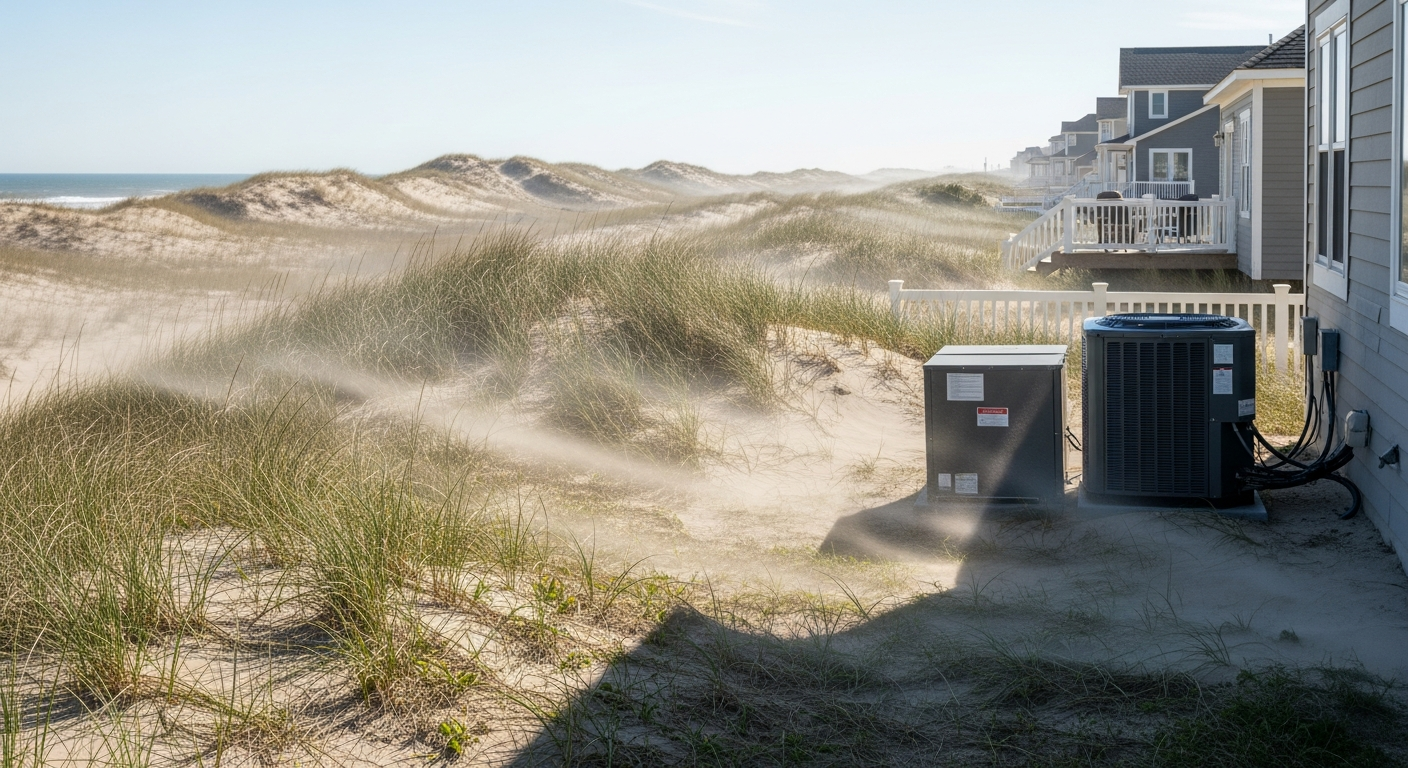
Ask anyone who lives in Sandbridge, Croatan, Chic's Beach, or the North End: the ocean breeze is one of the best parts of living in Virginia Beach. But that same steady onshore wind is a delivery service for fine sand, salt spray, and airborne allergens — and a surprising amount of it ends up inside your home's ductwork.
How Sand Actually Gets Into Your Ducts
Beach sand doesn't just track in on flip-flops. The finest particles — the powdery grit you find on windowsills after a windy weekend — stay suspended in the air and enter your home through open doors, window screens, bathroom and dryer vents, and tiny gaps in the building envelope. Once inside, your HVAC return pulls that gritty air through the system, and the heaviest particles settle in the ductwork's low spots, elbows, and boots.
Homes within about a mile of the Oceanfront or the Chesapeake Bay shoreline collect this abrasive dust year-round. Over a few seasons it builds into a genuine layer of sediment that no filter change can remove.
Why Coastal Grit Is Worse Than Ordinary Dust
- It's abrasive. Silica particles wear on blower motors, bearings, and coil fins, shortening equipment life.
- It's salty. Salt crystals attract and hold moisture, accelerating corrosion inside duct runs and encouraging the damp conditions that let mold take hold in our humid climate.
- It carries allergens. Coastal winds don't just move sand — they mix in pollen from bayside pines and oaks, mold spores from the dunes and marshes, and microscopic debris that irritates allergies and asthma.
- It clogs filters fast. Oceanfront homes often need filter changes twice as often as inland homes. If your filters gray out within weeks, wind-blown grit is the likely culprit — our filter replacement service can put you on the right schedule.
Signs of a Sand-Loaded System
Gritty dust that reappears on furniture within a day or two of cleaning, a faint scouring sound in the air handler, registers with dark, dense buildup at the edges, and weakening airflow room by room. Because sand settles deep in the duct runs, the only way to know for sure is to look — which is why we photograph the inside of your system during a free photo inspection.
Protecting a Beach Home's Air System
Get the grit out. Professional air duct cleaning with a direct-contact brush-and-vacuum system pulls sand and sediment out of the entire duct network, not just the visible registers. For Virginia Beach homes, we recommend an inspection every couple of years — more often within sight of the water.
We’re in salt-air neighborhoods like the Oceanfront / Resort Area, Sandbridge, and Chic’s Beach every week — visit your neighborhood page to see recent jobs and reviews near you.
Seal the envelope. The same gaps that admit sandy air also leak conditioned air out. Proper attic and crawl space insulation makes a coastal home dramatically more dust-resistant — our sister company Universal Insulation Doctor in Virginia Beach can air-seal and insulate the weak points.
Mind the crawl space. Sandy, moist coastal soil around beach homes is prime territory for ants, termites, and other pests that exploit the same entry gaps. Universal Pest & Termite in Virginia Beach protects thousands of local homes from exactly this.
Local Ducts, Local Knowledge
We've cleaned duct systems from Sandbridge cottages to Great Neck colonials for over 26 years, and coastal grit is one of the most common things our cameras find. Curious what else our regional climate does to ductwork? Read about humidity-driven duct mold across Hampton Roads and spring pollen season in Chesapeake — or explore everything we do across the region on our Hampton Roads duct cleaning guide.